
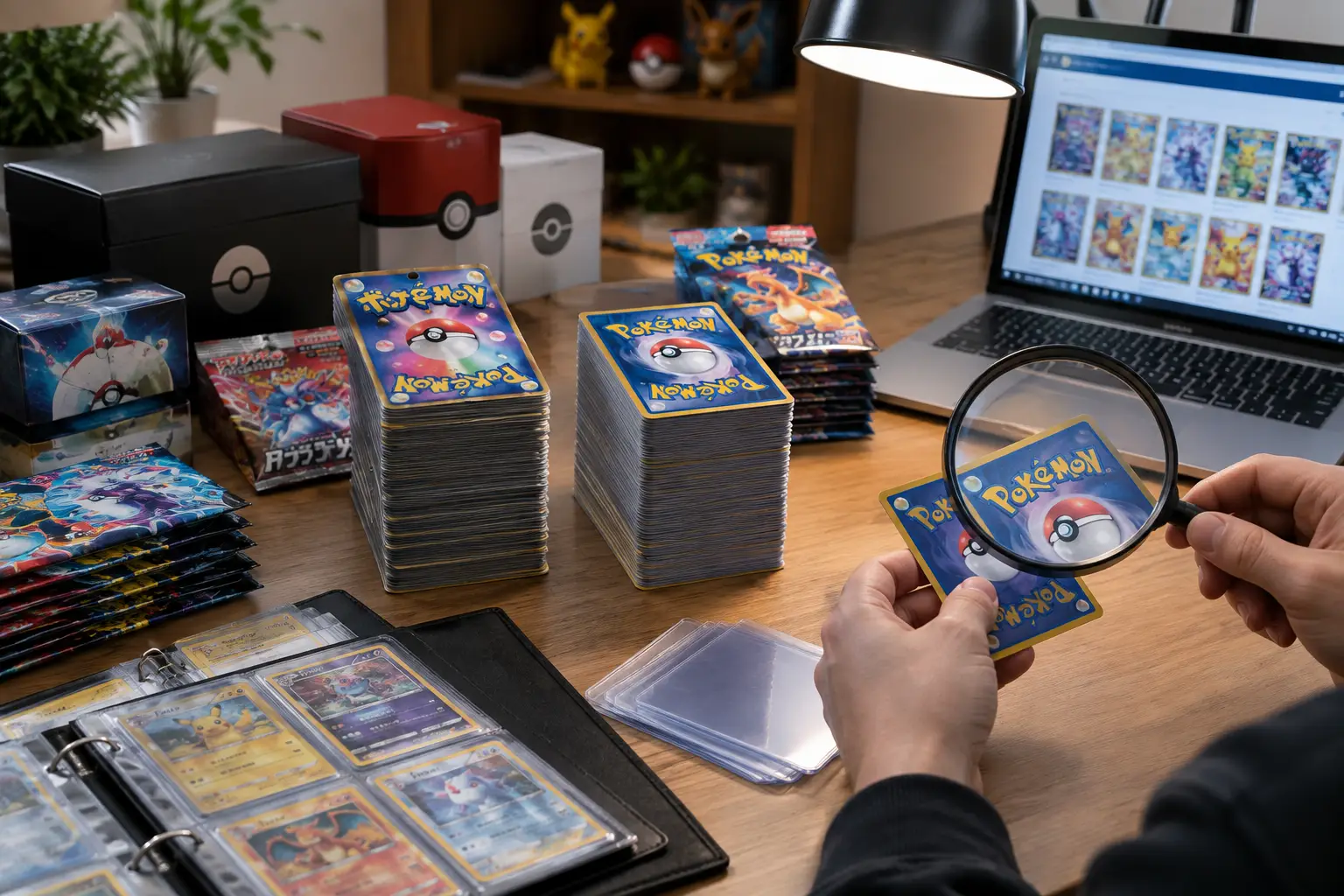
That first look at a Japanese Pokémon holo can stop a collector in their tracks. The foil pattern catches differently, the card text feels fresh, and a familiar Pokémon can suddenly feel like a completely different piece for the binder. The search for “Japanese English cards” usually comes down to one question: should you collect the Japanese printing, the English printing, or both?
There is no one right answer. Japanese and English Pokémon cards often share the same characters, artwork, and set themes, but they can differ in release timing, card treatment, availability, price, pull experience, and tournament use. Knowing where those differences matter helps you spend on cards that actually fit your collection.
Japanese vs. English Cards: Start With Your Goal
Before comparing prices or chasing a specific alternate art, decide what you want the card to do. A player building a deck for local events needs a different answer than a collector putting together a favorite Pokémon page or a parent buying packs for a young fan.
English cards are usually the practical choice for players in the United States. The text is easy to reference during a game, set names match what most local players recognize, and English products are the standard for North American Pokémon events. If you are building a deck, buying English singles is often the simplest route.
Japanese cards can be a great fit when the artwork, print treatment, or early release matters most. Japan often receives sets before their English counterparts, and Japanese exclusive promos, box toppers, and special releases give collectors plenty to chase beyond the English release calendar. For a binder focused on favorite Pokémon, Japanese cards can add variety without repeating the exact same card experience.
A mixed collection is completely valid, too. Plenty of collectors keep English cards for playable decks and Japanese versions for their favorite artwork, vintage holos, promos, or higher-end display pieces.
Why Japanese Pokémon Cards Feel Different
Japanese Pokémon cards are not automatically better than English cards, but they do have qualities that collectors notice right away. Print quality can feel especially sharp on modern Japanese cards, with clean edges, crisp color, and tightly centered artwork appearing more consistently on many releases. That does not mean every Japanese card is perfect, or that every English card has poor quality control. Condition should always be checked card by card, especially when you are buying singles.
The product format is different as well. Japanese booster boxes commonly have fewer packs and fewer cards per pack than English booster boxes. The configuration, guaranteed hit patterns, and secret rare structure may also differ. That can make opening Japanese product feel more predictable in some sets, while English openings can feel more swingy from box to box.
Neither experience is automatically more fun. Some collectors like the rhythm of Japanese boxes and their compact pack sizes. Others want the larger English packs, familiar card text, and the chance to open cards that fit directly into their decks. If opening packs is part of the hobby for you, buy the format you will enjoy opening, not just the one somebody claims has better pulls.
Set Lists Do Not Always Match One for One
One of the biggest points of confusion is assuming a Japanese set always becomes one English set. Often, English Pokémon expansions combine cards from multiple Japanese releases, promos, or special subsets. A card that appears in a Japanese set today may arrive later in English as part of a different expansion, a box promo, or a special collection.
That matters when you are trying to complete a set. A Japanese checklist may be shorter and more focused, while the related English release can be larger and include cards from several sources. Read the set symbol, card number, and rarity rather than relying only on artwork. The same Pokémon and artwork can exist in both languages but be considered different cards for collection purposes.
Price Is About Demand, Not Just Language
It is tempting to assume Japanese cards are always cheaper or English cards are always more valuable. The market does not work that neatly. Price depends on the specific card, the character, the artwork, the rarity, the condition, the supply available, and what collectors are currently chasing.
For many modern cards, a Japanese version may cost less than the English equivalent because Japanese product is printed at a different scale and certain cards enter the market more quickly. In other cases, Japanese promos and exclusive releases can command serious collector interest because they were never part of a regular English product line.
The card itself matters more than the language label. A popular Charizard, Pikachu, Eevee evolution, or trainer card with standout artwork may carry demand in either language. Vintage Japanese holos can also be desirable for their history, original presentation, and connection to the earliest Pokémon releases.
When comparing two versions, look at condition first. A clean near-mint card with strong surface, corners, and centering may be a better addition than a cheaper copy with scratches or whitening. For cards you may eventually grade, inspect them closely instead of assuming a card is grading-worthy because it came from a fresh pack.
Playability and Japanese English Cards
For casual kitchen-table games, use the cards that make the game enjoyable for your group. If everyone knows the effects, a Japanese card can still be a fun part of a casual deck. Keep a readable translation available so there is no confusion over attacks, abilities, or trainer effects.
For sanctioned play in the United States, English-language cards are the safest choice. Tournament rules and accepted card languages can vary by region and event, and Japanese cards are generally not the standard for Play! Pokémon events outside Japan. Check with the tournament organizer before showing up with cards in another language.
That distinction makes English cards a better buy for a competitive deck, while Japanese cards make more sense as collector pieces, trade binder highlights, or personal favorites. If your budget allows only one version, let your main hobby goal decide.
How to Buy Japanese Cards With Confidence
Japanese product deserves the same careful approach as any collectible product. Buy from a card shop or seller that understands the hobby, can identify authentic sealed products, and is clear about what you are getting. Japanese booster boxes, packs, promo packs, and singles all have their own packaging details, so familiarity matters.
Be cautious with loose packs when you do not know the source. Some products have predictable hit structures, which can make loose-pack buying more complicated than grabbing a sealed box or a verified single. A loose pack is not automatically a bad purchase, but it should be priced and presented honestly.
For singles, ask about condition and look closely at photos when possible. Surface scratches show up easily on dark cards and holofoil. Centering, edge wear, dents, and print lines can all affect how a card looks in a binder and how it may perform if submitted for grading.
At Waterfront Card Shop, the goal is to make those choices easier whether you are picking out your first Japanese pack, hunting an English single for a deck, or comparing versions of a card you have been chasing.
Build the Collection You Want to See
There is something especially satisfying about putting the Japanese and English versions of the same card side by side. You can see the different holo treatments, set layouts, rarity stamps, and small design choices that make each release its own collectible.
Start with one Pokémon, one artist, one era, or one set instead of trying to chase everything at once. Maybe that means an English deck built to play at locals and a Japanese binder page for your favorite starter. Maybe it means a single vintage Japanese holo that reminds you where the hobby began. The best card is not the one someone else says you should own - it is the one that makes you want to take the binder back off the shelf.