
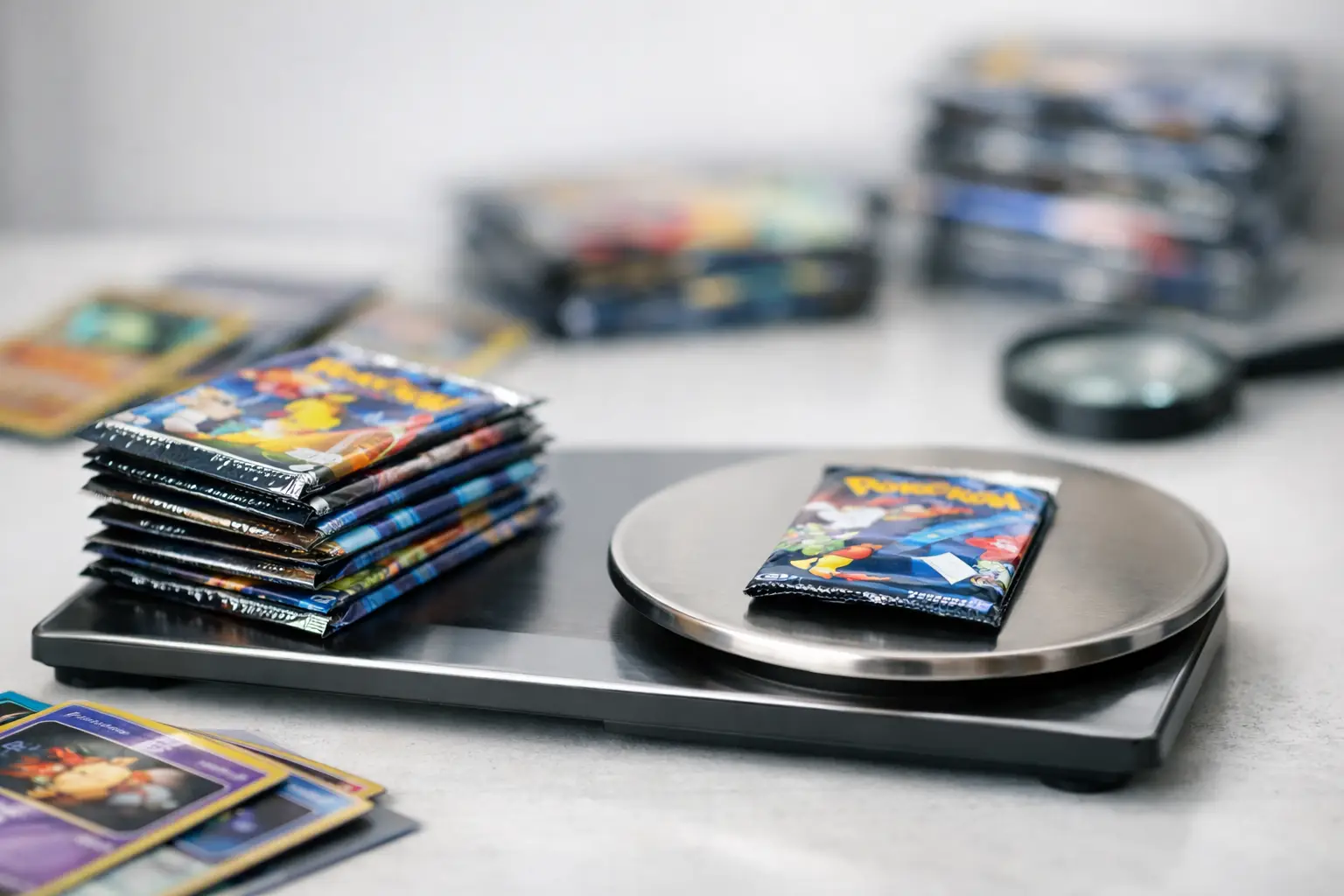
A booster pack that is a fraction of a gram heavier can spark a lot of debate at the card table. That curiosity makes sense: for years, collectors used scales to hunt for holographic cards. But why Pokemon packs weigh differently is more complicated than “heavy means hit.” Modern pack design, card treatments, code cards, wrappers, and normal factory variation all play a part.
For collectors buying sealed product, the practical takeaway is simple: pack weight is not a guarantee. It can offer a clue in certain older products, but the clue is often weaker than people expect, especially with current English Pokémon releases.
Why Pokemon Packs Weigh Differently
A sealed booster contains more than its cards. The foil wrapper, adhesive, ink, card stock, code card, and even the amount of air trapped inside all contribute to its total weight. Manufacturing aims for consistency, not identical pack weights down to the last hundredth of a gram.
A small difference can happen before anyone even considers the card pull. Two packs from the same booster box may have slightly different wrapper folds or glue placement. One may contain a code card with a different print or stock variation. Humidity and scale accuracy can also change a reading enough to make a pack look suspiciously light or heavy.
That is why a digital scale can measure a difference without explaining what caused it. Weight is data, but it is incomplete data.
The Original Reason Collectors Weighed Packs
In many older Pokémon sets, a regular holographic rare used more foil than a non-holo rare. That additional foil could make a pack noticeably heavier. If every other component was consistent enough, a careful buyer could separate likely holo packs from likely non-holo packs.
This is where the term “heavy pack” came from. In some vintage and older eras, weighing could be reasonably effective when done with a precise scale and a large enough group of packs from the same product. It was never a perfect science, but the weight gap could be meaningful.
The problem is that the hobby did not stay there. Pokémon products evolved, and pack collation changed with them. A method that had some value for one set can be nearly useless for another.
Foil cards can add weight
Traditional holofoil layers, reverse holos, and certain premium finishes may weigh more than plain card stock. In an older set with a predictable card layout, that extra material sometimes created a measurable pattern.
The key word is sometimes. Card printing is not perfectly uniform, and a difference of a few hundredths of a gram does not automatically point to a holographic card. A scale cannot identify the card inside a pack.
Older pack styles were more predictable
Vintage-era packs often had simpler contents and fewer variables. When the rare slot was either non-holo or holo, weight had a clearer connection to the possible pull. This is why older loose packs deserve more caution than modern loose packs, particularly when the seller cannot explain where they came from.
A “light” vintage pack may still be a fun piece of sealed history, but it should not be priced or presented as though it has the same odds as an unweighed pack from a fresh source.
Modern Pokémon Packs Are Harder to Weigh Reliably
Modern English Pokémon booster packs generally include a reverse holo or another foil treatment in every pack. That immediately reduces the old weight advantage because both hit packs and non-hit packs can contain foil material.
Code cards have also been a major variable across different eras. Some releases used code cards with different weights, colors, or card stock types. In certain products, collectors noticed patterns between code-card types and the contents of the pack. Pokémon has changed packaging and collation practices over time, so any pattern seen in one print run should not be treated as a permanent rule.
Special card treatments add even more noise. Full-art cards, Pokémon ex cards, illustration rares, ultra rares, secret rares, textured cards, and different reverse-holo patterns do not all weigh the same. Yet the difference may be offset by the code card, wrapper, glue, or ordinary print variation.
As a result, a heavy modern pack might contain a better card, a different code card, a slightly heavier wrapper, or nothing unusual at all. A light pack can still contain a chase card. Anyone claiming they can reliably weigh every current Pokémon set should be met with healthy collector skepticism.
Pack Weight Depends on the Set and Region
There is no single answer that applies to every Pokémon product. Set design matters, and English and Japanese products are not packaged the same way.
Japanese booster packs are often more uniform in card count and pack construction, but that does not mean they are safely predictable by weight. Their pull structures can vary by set, and some Japanese products use boxes or configurations where guaranteed pulls affect how collectors think about odds. Loose packs removed from a box can still create uncertainty, even if they were never weighed.
English products introduce their own variables. Different expansions, printing facilities, production runs, and packaging updates can affect pack weight. A conclusion drawn from one booster box should not be treated as proof for every box, every case, or every reprint.
This is also why social media tests can be misleading. Opening a handful of packs and finding that the heaviest one had a hit makes a great video. It does not establish a reliable rule. To prove a pattern, someone would need a large sample from the same set, release period, and product configuration, then compare results across multiple boxes.
What This Means When Buying Loose Packs
Loose booster packs are not automatically bad. Plenty come from legitimate box breaks, collection sales, event prizes, and shops that sell individual packs for customers who want an affordable rip. The real issue is transparency.
Ask how the packs were sourced. Packs pulled directly from a newly opened booster box are different from a mixed stack with no history. If a seller has opened part of a box and already pulled major hits, the remaining packs may still be factory-sealed, but their practical appeal can change depending on the set’s pull structure.
For older packs, ask whether they have been weighed. A trustworthy seller should answer directly. “Unweighed” is only useful when the source is credible, because there is no visual test that proves a pack was never put on a scale.
For modern packs, weighing is less useful, but buyer confidence still matters. Look for clean seals, consistent crimping, intact wrapper edges, and a seller who understands the product. A pack with unusual tears, loose seams, or signs of resealing is a different concern from a normal weight variation.
At Waterfront Card Shop, sealed product and loose-pack conversations should feel straightforward: know what you are buying, ask the question, and enjoy the hobby without needing to turn every rip into a forensic investigation.
Better Ways to Protect Your Opening Experience
If your goal is the fairest possible chance at a chase card, sealed booster boxes, sealed bundles, and sealed collection products usually offer more confidence than random loose packs with an unknown backstory. That does not mean every sealed item has identical odds, but it gives you a clearer chain of custody.
For gifts, younger collectors, and casual openings, a reputable local card shop can help match the product to the moment. A booster bundle may make more sense than one loose pack. A sealed tin may be more exciting for a birthday. A single card may be the smarter choice when the goal is one specific Pokémon rather than the thrill of pulling it.
Collectors should also separate pack value from expected pull value. An older pack can be valuable because it is scarce, visually iconic, or hard to find in clean condition. Opening it for a holo chase is a personal decision, but weighing discussions should not distract from the fact that sealed vintage is its own collectible category.
The best pack is the one you can open with clear expectations. Buy from a source you trust, treat weight claims as set-specific rather than universal, and let the surprise stay where it belongs: inside the wrapper.