
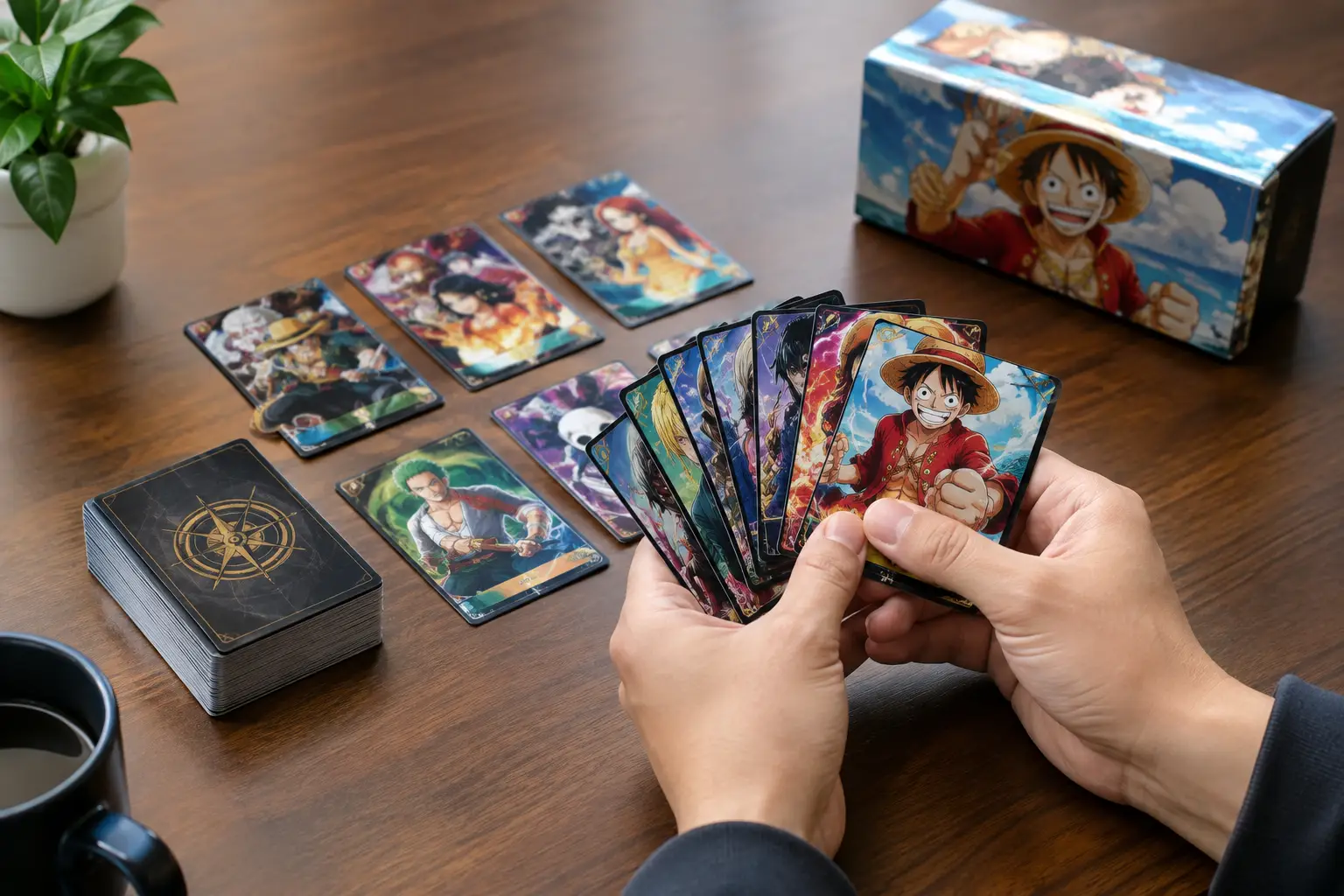
A great pull can be the spark for a deck, but it is rarely the whole deck. When you build One Piece decks, the goal is not to cram in every favorite character from an arc. It is to give your Leader a clear plan, then choose cards that help execute that plan turn after turn. A deck that feels focused will usually play better than a binder page full of powerful-looking singles.
The One Piece Card Game is welcoming to new players, but deck building has real depth. Your Leader sets the colors you can use, your DON!! curve determines what you can do each turn, and your event, Character, and Stage choices all affect consistency. Start with a deck that does one thing well. Once you understand why it works, upgrades become much easier.
Start With a Leader and a Win Plan
Every deck begins with its Leader. Besides determining your life total, power, and Leader ability, it establishes the card colors available to you. That color identity is the first filter for every card you consider.
Before buying singles or opening more sealed product, ask one straightforward question: how does this deck expect to win? Some Leaders want to attack aggressively and pressure life early. Others gain value by resting opposing Characters, building a wide board, reducing costs, manipulating the top of the deck, or going longer with powerful late-game cards.
Your answer does not have to be complicated. “I want to attack fast and finish before my opponent stabilizes” is a plan. So is “I want to control their board until my larger Characters take over.” If a card does not advance that plan, it needs a very good reason to occupy one of your 50 deck slots.
This is where favorite characters and competitive choices sometimes pull in different directions. There is nothing wrong with building around the Straw Hats, Navy, Animal Kingdom Pirates, or another crew you enjoy. Just look for cards whose traits and effects actually support each other. Theme decks are more fun when the theme also functions on the table.
Know the Basic Deck-Building Rules
A standard One Piece deck uses one Leader card and exactly 50 cards in the main deck, plus a separate deck of 10 DON!! cards. In most cases, you may include up to four copies of a card with the same card number. Your Leader does not count toward the 50-card main deck.
Those limits make every inclusion matter. Four copies are usually reserved for the cards you want to see reliably, such as a key searcher, early blocker, core removal piece, or major finisher. Cards that are useful only in certain matchups may belong at two or three copies instead.
Rules, errata, and tournament ban or restriction lists can change as the game develops. If you plan to play in a tournament, check the current official rules before locking in your list. A local event is a great place to ask questions, but legality is ultimately something each player should confirm.
Build One Piece Decks Around a Real Curve
A deck can have the right colors and the right characters yet still stumble because it has no usable curve. Your curve is the spread of card costs across the deck. It should give you meaningful plays from the early turns through the endgame.
Low-cost cards establish your board, search for pieces, defend life, or create early pressure. Mid-cost cards often form the working core of the deck: efficient attackers, blockers, utility Characters, and removal. High-cost cards should swing the game, protect a lead, clear threats, or provide a finish that smaller cards cannot.
The correct ratios depend on the Leader. A fast deck normally wants more cards it can play cheaply, while a control deck may accept a slower opening in exchange for stronger late turns. What matters is avoiding hands that do nothing. If you routinely draw several expensive cards early, lower the top end. If you run out of useful plays after turn three, add more midrange value or card advantage.
Do not forget that Counter values are part of the curve too. A hand with plenty of playable cards but very little counter can leave you unable to protect your Leader or important Characters. When comparing similar cards, a 1,000 or 2,000 Counter can be a major reason one makes the deck and another stays in the trade binder.
Give Every Card a Job
The cleanest way to evaluate a card is to name its job. Most cards in a well-built list fill one or more of these roles:
- Early pressure or board development
- Searching, drawing, or card selection
- Defense through Counter, blockers, or protection
- Removal and disruption
- A payoff that closes the game or creates a large advantage
You do not need equal numbers of every role. An aggressive red list and a defensive blue or black list should not look identical. Still, labeling cards exposes gaps quickly. If 18 cards are finishers and only a handful help you survive the early game, the deck is telling you where the problem is.
Searchers deserve special attention. They are strongest when they can find a large portion of your deck, not just a few scattered targets. If your searcher looks for a specific trait, build enough of that trait into the list to make the effect dependable. Mixing several unrelated engines can make a deck feel exciting while making its best turns much less consistent.
Events should earn their space as well. A powerful event that stays in hand because it is too situational is not helping. Include events that fit your expected games, support your Leader’s plan, or provide a defense your Character lineup cannot cover. Test whether you are happy to see the card early, late, or while behind. The answer often reveals the right copy count.
Test the List Before Chasing Every Upgrade
It is tempting to solve every loss by buying another high-demand single. First, play enough games to identify what actually went wrong. Did you lose because you could not find your key cards? Were your early turns too slow? Did you overcommit to the board and lose to removal? Or did you simply face a matchup that naturally challenges your strategy?
Goldfish a few opening hands before your next game night. Draw five cards, decide whether you would mulligan, then play out your first four or five turns by yourself. This simple exercise highlights clunky hands, awkward costs, and cards that have no clear turn to be played.
Then test against different styles of decks. A list that handles a slower strategy may struggle against fast pressure, while a deck built to beat wide boards may have trouble with a single large threat. Do not rebuild after one bad game. Look for patterns across several matches, then make small changes, usually two to four cards at a time.
Keeping a quick note on those changes helps. Write down what you removed, what you added, and why. After a few sessions, you will know whether a card was genuinely weak or whether it just showed up in the wrong game.
Upgrade With a Budget, Not a Shopping Cart
Starter decks are an excellent foundation because they give you a functional Leader, a recognizable strategy, and immediate games to play. A smart first upgrade is often adding extra copies of the cards already central to that strategy, then improving the weakest slots with targeted singles.
You do not need the most expensive version of every card to have a deck you enjoy. Alternate-art and manga rares are exciting collector pieces, but the regular printing of a playable card can be the better choice for a player focused on a weekly event. Condition matters for collectors, while playability and legality matter most for a tournament deck. Both approaches belong in the hobby.
Set a number before you shop. Maybe this month means completing a playset of a key card; next month means improving your matchup against board-heavy decks. Trading extra pulls can also turn unused cards into the pieces your list actually needs. At Waterfront Card Shop, a conversation about your Leader and budget can make it easier to sort useful upgrades from impulse buys.
Bring a List You Can Explain
The best deck is not always the one that won the latest major event. Meta lists are useful references, especially for understanding ratios and proven card packages, but they may assume expensive staples or a local field different from yours. Copying a list card for card can be a good starting point. Understanding its choices is what makes it yours.
Bring your list to casual play, ask opponents what felt difficult to answer, and be open to learning from losses. A well-built One Piece deck gets sharper over time, one adjustment and one memorable game at a time.