
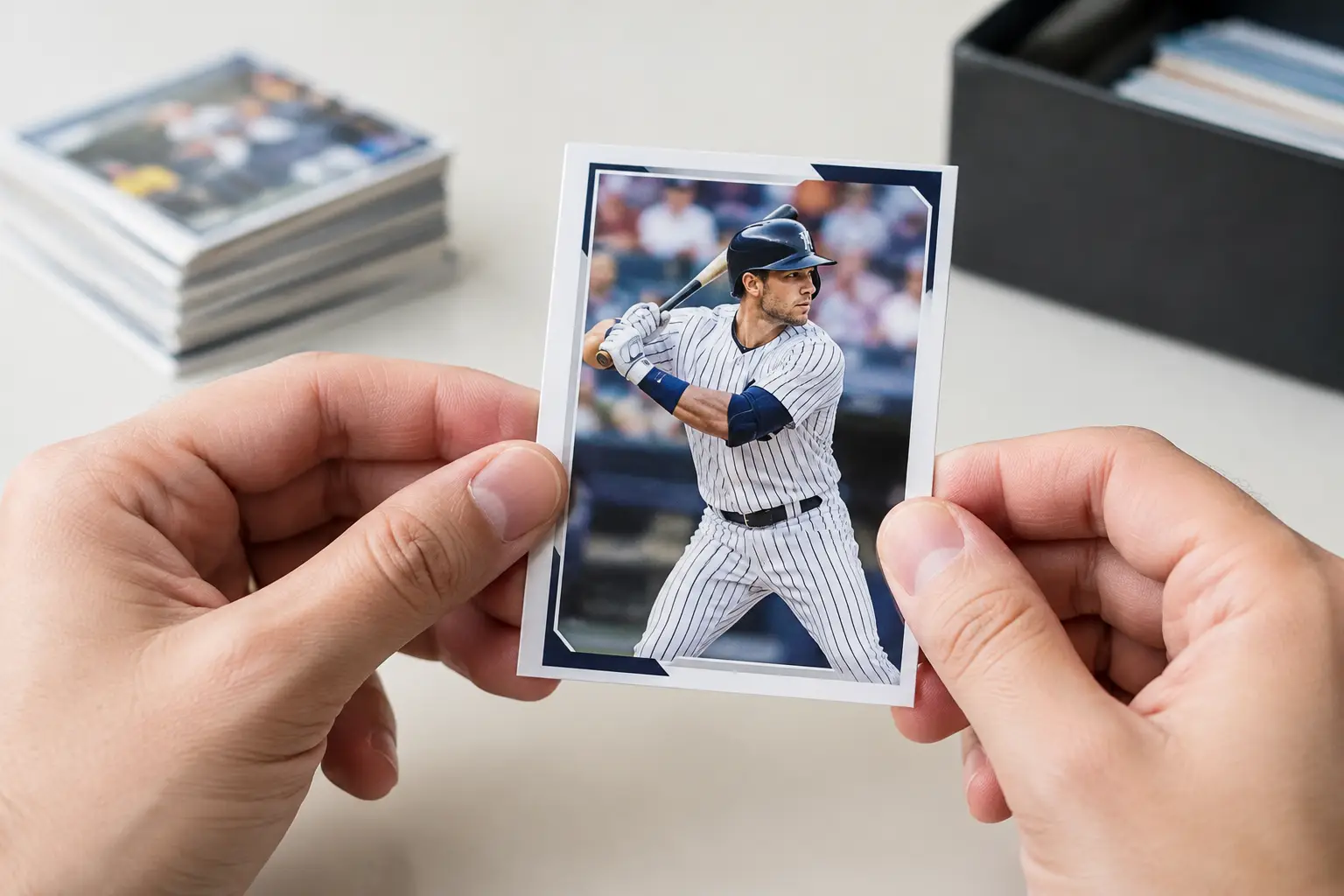
A card can look flawless at first glance, then show a noticeably heavier border on one side once it is under good light. Knowing how to inspect card centering helps you buy singles with clearer expectations, decide whether a card is worth grading, and avoid surprises when a favorite pull comes back with a lower grade than you hoped.
Centering is only one part of condition. Corners, edges, surface, print lines, scratches, and factory defects all matter too. Still, it is one of the easiest things to check before a purchase because you can often spot an issue without touching the card.
What Card Centering Actually Means
Centering is the balance of the printed card design inside the physical edges of the card. On many Pokémon, One Piece, and sports cards, you can judge it by comparing the border thickness on the left and right, then the top and bottom. If the borders are close in size, the card is well centered. If one border is clearly wider, the image is shifted toward the opposite edge.
A card can be off-center left to right, top to bottom, or both. A card that is slightly shifted vertically may still look great in a binder. A card with a narrow left border and a very wide right border, however, will stand out quickly, especially on modern cards with clean, bold frames.
Centering does not necessarily make a card less fun to own. It may not even change its value much for a raw card you are buying for a personal collection or a playable deck. The stakes change when you are paying a premium for condition or considering a grading submission.
How to Inspect Card Centering in Person
Start with a clean, well-lit view. Hold the card flat at eye level or lay it on a dark, plain surface. Avoid checking through a cloudy penny sleeve, a scratched top loader, or a binder page if possible. Those can distort the edges and make a centered card look uneven.
Look at the front first. Compare the left and right borders, then the top and bottom borders. Your eyes are usually good at catching a meaningful difference, particularly when you give the card a few seconds instead of making a quick judgment at the counter.
Next, check the back. This step matters more than many collectors realize. On cards with blue Pokémon backs or strong sports-card border designs, off-centering can be easier to see on the reverse than on the front. A card may have a balanced front but a noticeably shifted back. Grading companies inspect both sides, so do not assume a sharp-looking front tells the full story.
If you are looking through a stack of cards, keep the comparison consistent. Place each card on the same surface and view it from the same distance. This makes it easier to spot the one copy with the most balanced borders rather than relying on memory.
Use the Corners as Reference Points
The printed frame near each corner can reveal whether the design is drifting. On a standard bordered card, trace the gap between the print and the physical edge from the upper left corner to the lower left corner. Then do the same on the right. If the gap stays fairly even and matches the opposite side, that is a good sign.
Be careful with textured cards, full-art cards, borderless cards, and designs that intentionally use uneven artwork. These do not always offer a simple border to measure. In those cases, use repeated design elements, text boxes, set symbols, or the placement of the back design as your guide.
Do Not Confuse a Bad Cut With Off-Centering
Centering refers to where the printed design sits. A miscut or poorly cut card is a separate issue. If the card itself is noticeably trapezoid-shaped, has a rough edge, shows part of another card, or has an unusually angled cut, the problem may be the physical cut rather than centering alone.
That distinction matters because some factory errors are collectible in their own right, while others simply limit the card's grade. If you think you have an error card, avoid trimming, cleaning aggressively, or trying to “fix” it. Keep it protected and get a second opinion from collectors who understand error cards.
A Simple Way to Measure Centering
For a closer check, use a clear centering tool, a small ruler with fine measurements, or a digital image with a grid overlay. You are comparing the visible border or margin on opposite sides, not measuring the entire card size.
Measure the left border and right border at roughly the same height. Then measure the top and bottom at roughly the same width. Turn those numbers into a ratio. For example, if one side is about 2 millimeters and the other is about 3 millimeters, the ratio is 40/60. That is a helpful shorthand for describing the balance.
You do not need laboratory precision for most collecting decisions. A quick ratio tells you whether the difference is minor or obvious. For a high-end card, though, small differences can matter, so take a straight-on photo and check more than one spot along the border. A tilted photo can make a card look more off-center than it really is.
Different grading companies publish their own standards and may allow different tolerances for front and back centering at each grade level. Those standards can change, and visual judgment is still part of grading. Treat a centering measurement as a screening tool, not a guaranteed grade prediction.
Centering on Raw Cards, Graded Cards, and Sealed Product
When buying raw singles, ask what your goal is. If you are building a Pokémon binder, completing a One Piece collection, or picking up a favorite rookie card, a slightly off-center copy may be the smarter buy if the price reflects it. You may get a clean, enjoyable card without paying a premium for a grade-ready specimen.
If you are buying with grading in mind, be stricter. Check both sides, use magnification for edges and corners, and inspect the surface under angled light. A card with excellent centering can still miss a top grade because of a tiny dent, print line, or whitening that was easy to overlook.
For already graded cards, the label tells you the final grade, but you should still inspect the card. Two cards with the same numerical grade can have different eye appeal. One may be nicely centered with a minor corner issue, while another may be visibly off-center but otherwise clean. Decide which one you would rather own before treating the number as the whole story.
Sealed product is different. You cannot inspect the centering of cards still inside a pack, box, or tin, and no sealed product promises a certain grade. Opening packs is part of the fun, but it is not a reliable way to source perfectly centered submission cards. If centering is your main priority, a carefully inspected single is usually the more direct route.
Common Mistakes When Checking Centering
The first mistake is judging from one photo. Seller photos can be angled, cropped, shadowed, or taken through plastic. Ask for straight-on front and back images when condition is a major part of the purchase. A clear photo against a neutral background is more useful than a heavily filtered close-up.
The second is overreacting to tiny differences. Factory-cut trading cards are not all perfectly centered, and a very small imbalance does not ruin a card. Focus on whether the shift is visible without forcing yourself to find it.
The third is looking only at the front. The back may be more off-center, and that can affect grading. Finally, do not let centering distract you from bigger defects. A card with slightly uneven borders but a clean surface and sharp corners can have stronger overall eye appeal than a centered copy with a crease or dent.
When a Slightly Off-Center Card Is Still the Right Card
Condition standards should match the card, price, and purpose. A low-cost card for a child’s collection does not need the same inspection as a vintage holographic card or a modern chase card headed for grading. Collect what makes sense for your budget and the way you enjoy the hobby.
At Waterfront Card Shop, collectors can compare singles in person, ask condition questions, and take the time to find a copy that fits their binder, deck, or grading plans. There is no shame in choosing the slightly off-center copy if it is the card you have been chasing and the price is right.
The best habit is simple: slow down before you buy. Give the front and back a careful look, compare the borders, and decide whether the card looks right to you. A card you are excited to pull from your binder and show another collector has already done a lot of what a great card should do.