
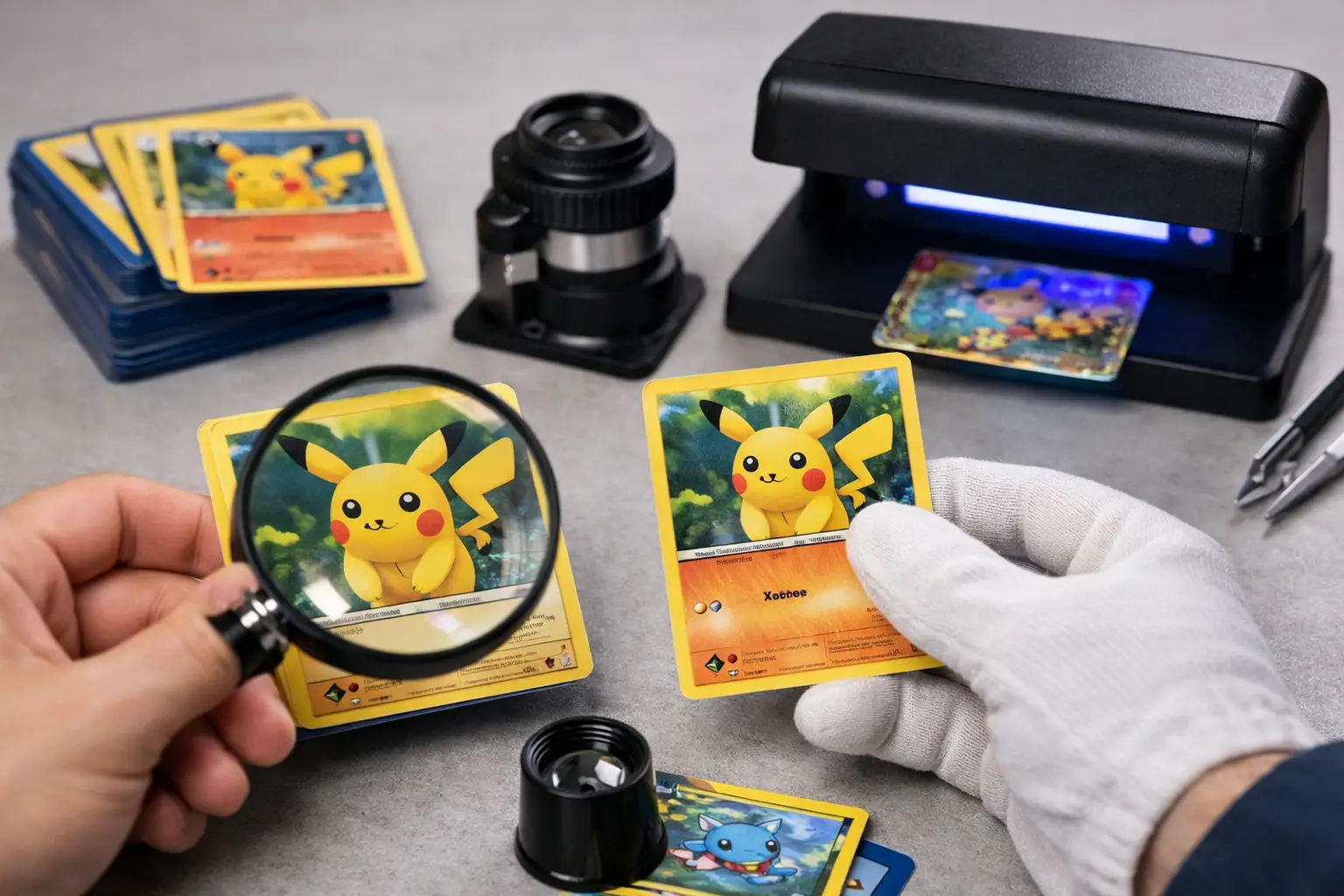
That $5 vintage holo, the too-good-to-be-true booster box, or the binder page full of childhood favorites can all raise the same question: is it real? Pokemon authenticity matters because a card’s value, playability, collectibility, and sentimental value all depend on it. Counterfeits are common enough that every collector, parent, and player should know the basic checks before spending money or making a trade.
The good news is that most fakes reveal themselves when you slow down and examine the item properly. You do not need a lab, a scale, or a stack of expensive equipment to catch many of them. You do need a real point of comparison, good lighting, and the willingness to walk away when something does not add up.
Why Pokemon Authenticity Is More Than a Price Check
Fake cards are not only a problem for high-end collectors chasing vintage Charizards or modern special illustration rares. They show up in bulk lots, loose packs, mystery bundles, online listings, schoolyard trades, and even binders sold at yard sales. Some are obvious, with incorrect fonts and washed-out colors. Others are made to look convincing from a distance, especially inside a sleeve.
Authentic Pokémon cards are printed to a consistent standard. The texture, card stock, holo pattern, layout, wording, set symbols, and color all follow rules established for that specific release. Counterfeit makers often get one or two details right, but they usually miss the full combination.
There is also a practical side for players. A counterfeit card cannot be used at official events, and a fake copy of a tournament staple can create an awkward situation at league or a local event. For collectors, a fake can turn a valuable pickup into a piece with no legitimate market value. For parents buying gifts, authenticity is about making sure the excitement of opening a pack or adding a favorite Pokémon to a binder is real.
Start With the Card in Your Hand
The fastest checks are visual and tactile. Take the card out of a sleeve, hold it under good light, and compare it with a known authentic card from the same era when possible. Comparing a modern card to a vintage card is less helpful because printing, holo treatments, and card texture have changed across Pokémon releases.
Check the back first
The classic Pokémon card back is one of the easiest places to spot a counterfeit. On many fakes, the blue border looks too light, too dark, overly purple, or flat compared with a genuine card. The yellow “Pokémon” lettering may have a weak outline, unusual spacing, or an incorrect shade. The Poké Ball can also look blurry, off-center, or printed with muddy red and white areas.
A real card back should look sharp without appearing digitally oversaturated. Minor factory print variation exists, so do not reject a card because of one tiny difference. Look for several problems together: poor color, blurry text, uneven borders, and flimsy stock tell a much clearer story than one detail alone.
Read the text, not just the name
Counterfeit cards regularly contain spelling errors, odd capitalization, missing accents, strange attack costs, incorrect HP, or clumsy wording. Modern Pokémon cards have specific formatting for abilities, attacks, weakness, retreat cost, regulation marks, rarity symbols, and copyright information. If the text feels wrong, it often is.
Pay attention to font quality, too. Genuine text is generally crisp and consistent. On a fake, letters may look too bold, too thin, fuzzy, poorly spaced, or slightly misaligned. The card may use a font that is close enough at a glance but clearly wrong beside a real copy.
Do not assume an unusual card is fake just because you have never seen it. Promo cards, foreign-language cards, older printings, misprints, and specialty releases can look different from standard pack cards. Verify the card number, set name, and release details before making a call.
Feel the card stock and surface
A real Pokémon card has a familiar, layered feel. It should not feel like regular printer paper, laminated cardboard, or a slick plastic playing card. Many fakes are noticeably thin, overly glossy, or too flexible. Others feel stiff but lack the textured finish used on many modern ultra rares and illustration rares.
Texture is useful, but it is not a universal test. Not every authentic rare card is textured, and counterfeit cards sometimes add fake texture. On a genuine textured card, the pattern usually lines up naturally with the artwork and printed design. On a fake, the texture may be generic, overly deep, repeated across areas where it should not be, or applied over text in a way that looks unnatural.
Use Light Carefully, Not Destructive Tests
The flashlight test gets mentioned constantly in card groups. The idea is simple: genuine Pokémon cards usually have a dark inner layer that limits the amount of light passing through the card, while many fakes let light shine through more easily.
It can be a helpful clue, especially when comparing two cards from the same era. It is not a final verdict. Card stock varies by language, print run, age, and condition. A heavily played authentic card may behave differently than a fresh modern card, and some better counterfeits can pass a basic light test.
Avoid the old “rip test.” Tearing a card to inspect its inner layer destroys it, creates a mess, and is unnecessary for most buying decisions. The same goes for bending cards hard, soaking them, or scraping surfaces. If authenticity is uncertain, preserve the item and get another opinion.
A jeweler’s loupe or phone camera with macro capability can help you inspect print patterns and edges, but use it as supporting evidence. Zoomed-in images can make normal printing dots look suspicious. The strongest method is still comparing the full card - front, back, finish, wording, and card stock - against a confirmed authentic example.
Sealed Products Need Different Checks
Loose packs and sealed boxes bring their own risks. A pack can be counterfeit, resealed, weighed, or opened and resealed with lower-value cards. A sealed booster box can have altered shrink wrap, mismatched packs, or packaging that does not match the actual set release.
Start with the packaging quality. Authentic products have clean seals, sharp printing, correct logos, readable copyright information, and packaging materials consistent with the product. Loose, crinkled, overly tight, or unusually glossy shrink wrap can be a concern, but packaging varies by era and region. A small seam or wrapper imperfection does not automatically mean a product was tampered with.
Look at the source just as closely as the product. A seller offering large quantities of scarce sealed items well below current market value should raise questions. So should listings that use only stock photos, avoid showing the bottom of a box, or refuse to provide clear images of the exact item. A low price can be a lucky find. It can also be the cost of skipping verification.
For older sealed products, the trade-off is even more serious. Opening a questionable vintage pack may answer one question while permanently removing any sealed value. If the pack is expensive and its history is unclear, seek an experienced opinion before opening it.
Common Red Flags When Buying Cards
One red flag alone does not prove a card is fake. A damaged genuine card can have worn edges, faded color, or a strange feel after years in a binder. What matters is the pattern. Be especially cautious when several of these signs appear at once:
- Prices far below the going rate for chase cards, sealed boxes, or vintage holos
- A seller using blurry photos, stock photos, or images that hide the card back
- Cards with spelling mistakes, incorrect symbols, or unusual font spacing
- Holofoil that covers areas it should not, or no holofoil where there should be one
- Thin, glossy, flimsy, or plastic-feeling card stock
- Lots containing impossible combinations, such as every card being an ultra rare
The same caution applies to online marketplaces and in-person deals. Meeting face-to-face is useful because you can inspect the card, but it does not guarantee authenticity. Buying online can be safe when a seller has clear photos, a credible history, and a fair return process. It depends on the item, the price, and how much uncertainty you are willing to accept.
Build a Better Buying Habit
The easiest way to protect your collection is to make authenticity part of every purchase, not something you investigate only after a card feels suspicious. Learn the current sets you collect. Keep a few confirmed real cards available for comparison. Check card numbering and set information before trading for an expensive single. If a deal feels rushed, pause it.
For children and newer collectors, the goal is not to turn every trade into an interrogation. It is to teach a simple habit: look at the back, read the card, feel the stock, and ask a trusted adult or hobby shop when something looks off. That habit protects both their binders and their confidence in the hobby.
A dedicated card shop can also be a practical resource when you are unsure about a high-value pickup, a vintage binder, or a sealed product. At Waterfront Card Shop, collectors can shop with the benefit of a hobby-focused environment where condition, releases, and legitimate product matter.
The best card purchases still feel exciting, whether you are ripping your first pack, finishing a master set, or tracking down a favorite childhood Pokémon. Take an extra minute to check what is in front of you. Real cards hold up to that closer look.