
That fresh pull may look like a grading candidate under the shop lights, but the details show up fast once you prepare cards for grading. A tiny surface scratch, a soft corner, or an overlooked print line can change the result - and the value - more than most collectors expect.
Submitting cards is exciting, especially when you have a Pokémon chase card, a clean vintage holo, a big sports rookie, or a One Piece hit with serious upside. The best approach is not to send every card that feels rare. Slow down, inspect it honestly, protect it correctly, and submit cards that make sense for your collecting goals or budget.
Start With the Question: Is This Card Worth Grading?
Grading is not automatically the right move for every valuable card. Fees, shipping, insurance, and turnaround time all matter. A card can be desirable raw, particularly if you want it for a binder, a deck, or a personal collection. On the other hand, a strong grade can add protection, buyer confidence, and value to the right card.
Start by considering the card's demand, raw value, potential graded value, and condition. Modern ultra rares and alternate arts can be tempting submissions, but they are also prone to factory print lines, off-centering, whitening, and surface marks. Vintage cards may have more collector demand at lower grades, so a card does not need to be gem mint to deserve a slab.
Be realistic about your goal. Are you chasing a top grade for your personal collection? Trying to preserve a childhood card? Planning to sell? Each answer can change which cards are worth sending.
How to Prepare Cards for Grading Before You Pack Them
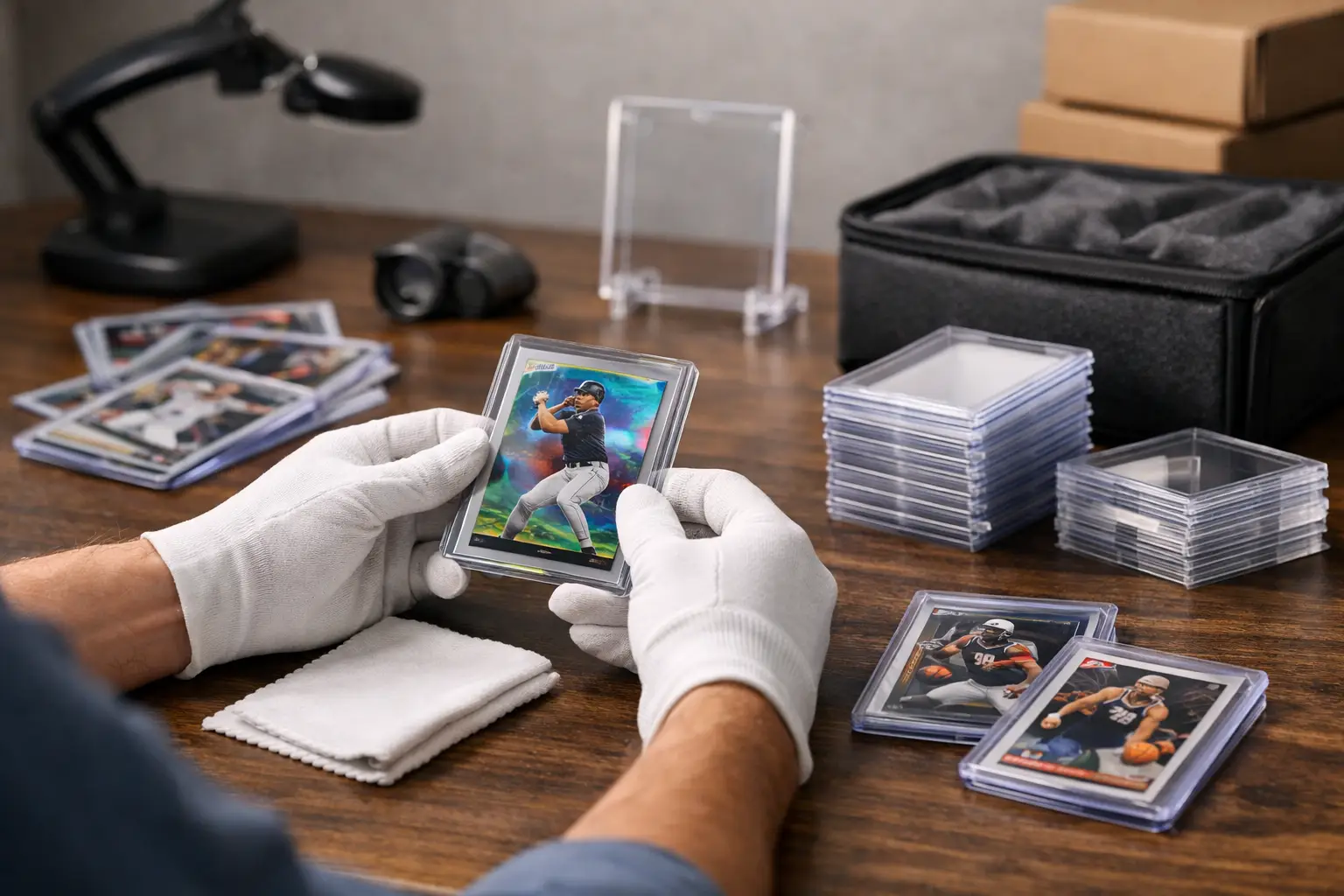
The inspection stage is where most of the real work happens. Give yourself a clean, dry workspace with good direct lighting. Natural light can help, but a bright desk lamp is often better for finding scratches and print defects. Handle cards by the edges, ideally with clean, dry hands. Gloves can reduce fingerprints, but they can also make cards easier to drop, so they are optional rather than required.
Look at both sides of every card slowly. Tilt the card under the light instead of only looking at it flat. This reveals dents, scratches, roller marks, indentations, clouding, and print lines that disappear at certain angles.
Check Centering First
Centering is one of the easiest flaws to spot, but it can be hard to judge by eye on busy card designs. Compare the border widths from left to right and top to bottom on both the front and back. A centering tool can help, especially when you are sorting a larger submission, but it does not replace a close visual check.
Do not assume a pack-fresh card is perfectly centered. Modern cards can come straight from sealed product with noticeable centering issues. If a card is already visibly off-center, it may still be worth grading for protection or a personal collection, but it is less likely to receive the highest grades.
Inspect Corners and Edges
Hold the card at an angle and inspect every corner. Look for whitening, softening, fraying, tiny bends, and exposed cardboard. Then check the edges from all four sides. Dark-backed cards often make whitening easier to spot, while light-backed cards can hide edge wear until they are under strong light.
For vintage cards, minor edge wear is common and should not automatically end the conversation. For modern cards you hope will grade near the top, even small flaws can matter. Keep your expectations grounded before you pay submission fees.
Examine the Surface Without Trying to Fix It
Surface condition is where collectors can accidentally create bigger problems. Check for fingerprints, scratches, dents, stains, print lines, holo scratches, and residue. Use your light at different angles, then inspect the card from a normal viewing distance as well.
Do not wipe a card with a tissue, paper towel, household cleaner, water, or abrasive cloth. Do not attempt to flatten a bend, press out an indentation, recolor an edge, or remove flaws with chemicals. Altering a card can damage it permanently and may lead to an altered-card designation if detected.
If there is loose dust on a modern card, a very gentle air blower may be safer than touching the surface. When in doubt, leave the card alone. Preservation beats a risky cleanup attempt.
Use Submission-Ready Protection
A card can be flawless when you inspect it and still arrive damaged if it is packed carelessly. The goal is to keep it stable, clean, and protected from movement during shipping.
Put each card in a new penny sleeve first. Old sleeves may have dust, wrinkles, or debris inside them. Then place the sleeved card into the holder required by the grading company you are using. Many graders prefer semi-rigid holders, often called Card Savers, while others may provide different instructions. Always follow that company's current submission rules instead of guessing.
Avoid forcing a card into a sleeve or holder. If the fit feels tight, stop and use the correct size. This matters even more for thicker cards, patch cards, relics, and specialty Pokémon promos with unusual dimensions.
For a submission with several cards, keep them in the same order as your submission form. A small pull tab on the penny sleeve can make removal easier for the grader, but keep tape away from the card and card opening. Secure the holders between firm pieces of clean cardboard, then use a team bag or similar outer protection to keep the stack together.
A few things are worth avoiding every time:
- Loose cards inside a box or mailer
- Cards shipped only in top loaders when the grader requests semi-rigids
- Rubber bands, which can bend holders and damage edges
- Tape placed directly on sleeves, holders, or cards
- Oversized boxes with empty space that lets the submission slide around
Use a sturdy box, add padding so nothing shifts, and choose shipping with tracking and insurance appropriate to the value of your cards. Photograph or scan the front and back of every card before mailing. Those images are useful for your records, your submission inventory, and any issue that may need to be documented later.
Build a Smarter Submission, Not Just a Bigger One
Collectors often save on shipping by building a larger submission. That can make sense, but only if each card clears your own condition and value threshold. Filling an order with borderline cards simply because there is room can turn an exciting return into a stack of disappointing grades.
Sort cards into three groups: clear submits, possible submits, and binder or raw-sale cards. Let the possible stack sit for a day, then inspect it again with fresh eyes. That quick pause can keep you from sending cards because of hype instead of condition.
It also helps to record the card name, set, card number, estimated raw value, expected grade range, and why you are grading it. You do not need to predict an exact grade. The point is to make a decision you can stand behind once the results arrive.
For younger collectors and parents, consider starting with a small group of favorite cards rather than a large expensive order. A first submission is a great way to learn how grading standards feel in real life. The returned cards can teach you more about centering, surface flaws, and the gap between pack-fresh and gem mint.
Know When a Local Second Look Helps
Some cards are easy calls. A card with a visible crease belongs in a personal collection or raw listing, not a high-grade gamble. Others are tougher: a clean-looking vintage holo with light scratching, a modern chase card with questionable centering, or a card whose value changes dramatically between grades.
That is where a collector-native second opinion can help. Bring a few candidates to Waterfront Card Shop in New Bedford, and talk through what you are seeing before you commit to a submission. No one can promise a grade, but another careful set of eyes may spot a flaw, identify a card with strong collector demand, or help you decide that the card is better enjoyed raw.
The cards that grade best are usually not the cards collectors handled the most. Set aside your strongest pulls early, sleeve them right away, and give them a careful inspection before they ever enter a binder, deck box, or trade pile.