
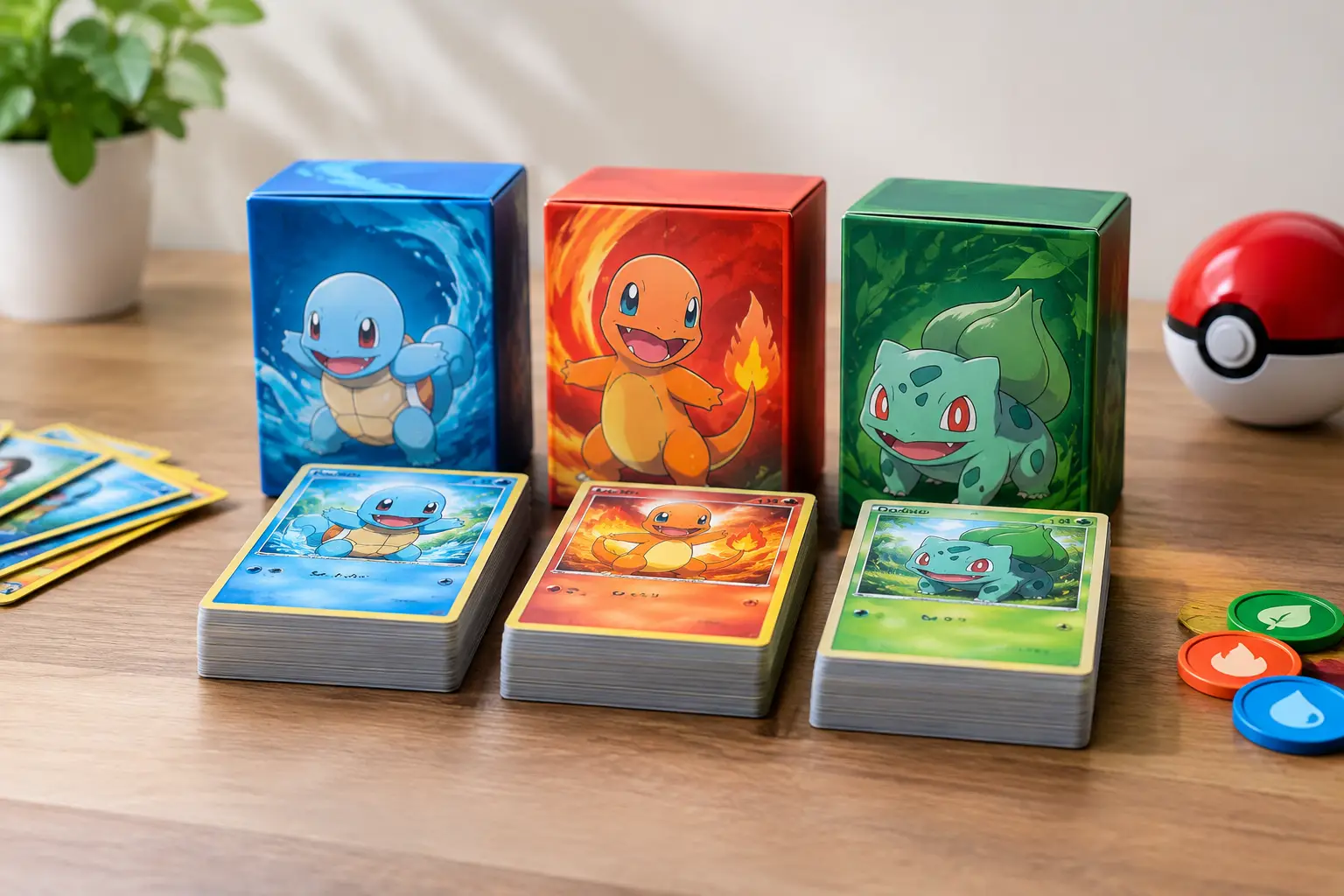
A pile of favorite Pokémon cards is a collection. A deck that can draw cards, find its attacker, and take Prize cards is a game plan. When you build Pokemon starter deck lists for the first time, the goal is not to copy a tournament-winning list card for card. It is to make 60 cards work together often enough that every game feels fun instead of frustrating.
For new players, parents, and collectors getting back into the hobby, the best first deck is usually simple, consistent, and easy to upgrade. Start with a Pokémon you actually want to play, then give it the support it needs to show up every game.
Start With One Clear Pokémon Plan
Pick one main attacker or one small group of attackers that share the same Energy type. A Fire deck, for example, should usually focus on Fire Energy rather than trying to run Fire, Water, Lightning, and Psychic cards just because those are the cards in the binder.
Read the attack cost before choosing your centerpiece. A Pokémon that needs one or two Energy to attack is much easier for a beginner to use than one needing four different Energy types. Also look at the damage, HP, retreat cost, and whether it is a Basic Pokémon or needs to evolve.
Basic Pokémon are the easiest place to start because they can be placed directly on the Bench. Evolution Pokémon can be powerful, but they require their earlier stages first. If your favorite attacker is a Stage 2, make room for enough Basic and Stage 1 cards to reach it reliably. A strong card stuck in your deck is not helping you.
For a first build, keep the strategy easy to explain in one sentence: "Set up this attacker, attach Energy, and keep it attacking." If the plan needs five different pieces before anything happens, save it for a later deck.
Build a Pokemon Starter Deck Around Consistency
Every standard Pokémon TCG deck has exactly 60 cards. The biggest beginner mistake is filling most of those slots with Pokémon and Energy, then having no way to draw into the cards needed at the right moment. Trainers make a deck function.
A useful starting range is about 15 to 20 Pokémon, 30 to 35 Trainer cards, and 8 to 15 Energy cards. Those numbers are not a rule. They change based on your Pokémon's attacks, abilities, and evolution lines. They are a dependable place to begin when you are building from singles, a starter product, or cards from recent packs.
Your Pokémon count should cover your setup without crowding out the support cards. If your main attacker is a Basic Pokémon, you may run several copies of it plus a few supporting Pokémon. If it evolves, use a clean evolution line. For example, a deck built around one Stage 1 attacker needs enough copies of the Basic form and the evolution to avoid constantly drawing one without the other.
Avoid the one-of-everything approach. Running multiple copies of the cards your deck needs most makes it more predictable. In normal deck construction, you can play up to four cards with the same name, except for Basic Energy and any card with a specific rule that says otherwise. If a Pokémon is central to your plan, two to four copies are usually more useful than one copy of four unrelated attackers.
The Trainer cards that keep games moving
Trainer cards do the unglamorous work that turns a stack of cards into a deck. Your first list should include ways to draw cards, search for Pokémon, find Energy, switch an Active Pokémon, and deal with an opponent's threat.
Supporter cards often provide the biggest draw effects, but you normally can play only one Supporter per turn. Item cards are more flexible and are especially useful for searching your deck or setting up your board. Stadium cards affect both players, so include one only when it clearly helps your strategy more than it helps the other side.
You do not need to memorize every competitive staple to start. Look through the Trainer cards you own and ask practical questions: Does this help me find my Basic Pokémon? Does it draw me out of a weak hand? Does it get Energy attached or recovered? Does it help when my Active Pokémon has a high retreat cost? Cards that answer those questions will usually earn a spot before a flashy Trainer with a narrow effect.
Choose Energy Based on the Attack Costs
Energy should be counted, not guessed. Look at how much Energy your main attacker needs and how quickly you can attach it. Since a player normally attaches just one Energy from hand per turn, attacks that require three or four Energy need a plan for getting there.
A straightforward starter deck with single-Energy attacks may run close to eight or nine Energy. A deck with heavier attacks, several retreat costs, or fewer ways to search for Energy may need 12 to 15. Start a little higher if you are learning, play several games, then reduce the count if you keep drawing Energy when you need Trainers.
Most beginning decks should use one main Energy type. Colorless attack costs are flexible because any Energy can pay them. Mixed-type attack costs are less forgiving. They can be worthwhile when the deck has strong Energy search or acceleration, but they create more missed attacks in a casual first build.
Test the Deck Before You Buy More Cards
Gold cards, special rarities, and chase pulls can be exciting, but they do not automatically improve a deck. Test your 60-card list with what you have before spending on upgrades.
Shuffle and draw a few opening hands. Can you usually start with a Basic Pokémon? Can you find another Pokémon for the Bench? By turn two, can you attach Energy and use an attack? These quick checks reveal problems fast.
Then play real games. Keep track of what causes the deck to stall. Maybe you have plenty of attackers but cannot find them. Maybe you evolve too slowly. Maybe your only strong attacker keeps getting stranded in the Active Spot. Make changes based on repeated issues, not one unlucky game.
A simple adjustment log helps: remove the cards that sat in your hand without helping, then add another copy of a card that solved a recurring problem. Change only a few cards at a time so you can tell whether the deck actually improved.
Upgrade With Purpose, Not Just Power
Once the deck plays smoothly, upgrades are easier to identify. You may want a stronger version of your main attacker, a better draw engine, more reliable Pokémon search, or a counter for a common local matchup. Pick the upgrade that fixes the deck's biggest weakness first.
Preconstructed decks and League Battle Deck-style products can also be a smart shortcut. They offer a playable foundation, then you can customize the list with favorite cards and targeted singles. Booster packs are great for the fun of opening and collecting, but they are not the most reliable way to finish one specific deck.
If you are building for a child or for kitchen-table games, durability and clarity matter as much as raw power. Use sleeves, keep the card text readable, and do not overload the deck with complicated effects. If you are preparing for organized play, check the current format rules and card legality before finalizing your list.
At Waterfront Card Shop, players can bring the idea of a deck, a few favorite cards, or a rough 60-card list and use that starting point to shop smarter. A focused deck build is usually more satisfying than chasing random additions to a binder.
Your first deck does not need to be perfect. It needs to give you a reason to shuffle up again, notice what worked, and make the next few card changes with a real plan.