
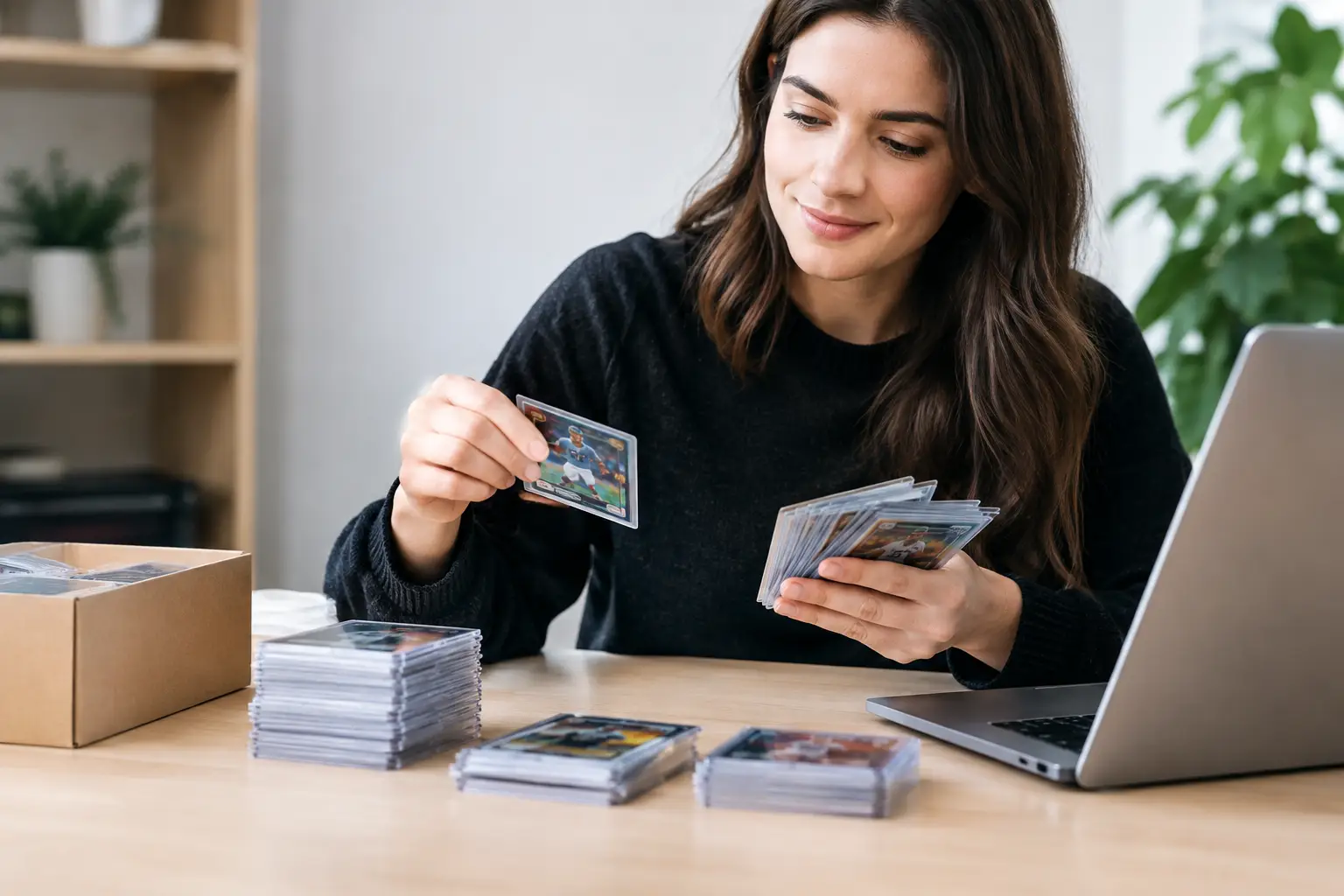
A stack of duplicate cards can look like clutter until you sort it the way a buyer would. Knowing how to sell duplicate cards starts with recognizing that not every extra card belongs in the same pile. A duplicate illustration rare, a playable trainer, and a common card from a recent set each have different buyers, different price expectations, and different best-selling methods.
For collectors around New Bedford and the South Coast, the goal is simple: turn extra cardboard into cash, store credit, or cards you actually want without accidentally selling a $20 card for bulk prices.
Sort duplicates before you price them
Do not start by listing every card you pulled twice. Start by separating your duplicates into groups based on condition, rarity, game, and demand. This makes the collection easier to evaluate and keeps a few valuable cards from getting buried in a common-card stack.
Pull out holofoils, reverse holos, full arts, illustration rares, secret rares, promos, vintage cards, numbered sports cards, autographs, relics, and cards that are staples in a current deck. Even lower-rarity cards can have real value when players need four copies for Pokémon, One Piece, Magic: The Gathering, or another game.
Then make a separate bulk pile for commons, uncommons, basic energies, duplicate code cards, and low-demand rares. Bulk has value, but it is usually sold by count or weight, not as individual cards. Keeping it separate saves time for you and the buyer.
Condition matters just as much as the card name. Check the front and back under good light for whitening, scratches, dents, bends, creases, edge wear, and print lines. A card can look clean in a binder but still grade as lightly played once it is in someone’s hands. Be conservative when describing condition. Buyers can forgive an honest lightly played card. They rarely forgive a near-mint card that arrives with whitening and a corner ding.
Identify the exact version of each card
Before setting a price, confirm what you have. Pokémon cards can share the same character name while coming from different sets, rarities, languages, and printings. Sports cards may have base versions, parallels, short prints, refractors, numbered versions, and rookie variations that look similar at a glance.
Use the card number, set symbol, year, rarity mark, and any numbering on the card to identify it. For modern Pokémon, the number at the bottom usually tells you much more than the character name alone. A Charizard is not automatically valuable, and a card that looks ordinary can be a sought-after promo or tournament staple.
Be especially careful with foreign-language cards, jumbo cards, celebration-style reprints, and vintage cards. They can still sell, but their buyer pool and price can differ significantly from an English standard-size version.
Price from recent sales, not asking prices
The biggest mistake sellers make is treating a high online listing as a market value. A card is worth what someone recently paid for a comparable copy, not what another seller hopes to get.
Look for recent completed sales of the exact card in a similar condition. Compare several sales instead of taking the highest or lowest one as your answer. If near-mint copies regularly sell for $12 to $15, pricing yours at $25 because one listing is still active will likely leave it sitting.
For cards under a few dollars, individual online listings often do not make financial sense after shipping materials, platform fees, and your time. Those cards can work better in a lot, as trade value, or in a bulk sale. On the other hand, a $30 chase card may be worth photographing and selling separately, especially if the condition is strong.
Prices also move around release windows. A newly released card can be expensive because supply is low, then fall once more product is opened. Competitive cards can rise when they show up in winning deck lists. Nostalgia-driven cards may jump when an anniversary, new set, or social-media trend brings attention back to a character. If you need cash now, price to the current market. If you are holding a card, understand that waiting is a gamble, not a guarantee.
Choose the selling method that fits the cards
There is no single best answer for how to sell duplicate cards because the right route depends on the value of the cards and how much effort you want to put in.
Selling to a local card shop is usually the fastest option. A shop may offer cash or store credit after checking condition and current demand. You will generally receive less than a direct-to-collector sale because the shop needs room to resell the card, cover operating costs, and take on inventory risk. In return, you avoid photographing, packing, shipping, handling returns, and waiting for an online buyer.
Store credit can be the better deal if you are building a deck, chasing cards for a binder, or picking up sealed product. At Waterfront Card Shop, bringing organized cards rather than a mixed backpack full of loose pulls helps make the process smoother for everyone.
Direct online sales can bring a higher percentage of market value, particularly for desirable singles. They also require accurate listings, clear photos, sleeves, top loaders or card savers when appropriate, secure packaging, postage, and patience. For a handful of higher-end cards, that work may be worthwhile. For 200 low-value duplicates, it usually is not.
Local collector groups, trade nights, and in-person meetups can be useful for playable cards and lower-end binder cards. Meet in a public place, agree on the card condition and price before exchanging, and avoid pressure to make a deal you do not understand. A friendly trade is still a transaction.
Make lots that buyers actually want
Lots work best when they solve a buyer’s problem. A random stack labeled “100 Pokémon cards” may sell, but it rarely brings as much interest as a clearly organized lot.
Consider grouping duplicates by set, character, type, team, era, or deck-building purpose. A lot of reverse holos from one set, a kid-friendly starter bundle, a Pokémon trainer card package, or a team lot for a sports fan gives buyers a reason to choose your cards over a generic bulk listing.
Be clear about what is included. If the lot contains holos, say how many. If cards are mostly common and uncommon, say that too. Do not use photos of your best cards if they are not included in the lot. Clear descriptions create fewer unhappy buyers and fewer awkward messages after a sale.
Protect cards while you sell them
A card can lose value between your binder and the buyer if it is handled carelessly. Put valuable singles in a clean penny sleeve, then a rigid holder or semi-rigid card saver. Do not tape directly onto a card sleeve. Keep cards away from food, moisture, direct sunlight, and loose stacks that can slide around in a bag.
For shipping, use enough protection to prevent bending and movement without making the package bulky or expensive. Photograph high-value cards before packing, including close-ups of corners and the back. This creates a record of condition and helps resolve disagreements.
Authenticity matters, especially with high-demand Pokémon cards, autographs, vintage holos, and premium sports parallels. If a card feels unusually glossy, has poor print quality, strange colors, or is priced far below the market, slow down. A fast sale is never worth passing along a card you are not confident is authentic.
Know when not to sell yet
Some duplicates are worth keeping. If you play the game, an extra copy may become useful for a future deck, trade, or format change. If you collect a favorite Pokémon, athlete, or set, you may prefer having a binder copy and a trade copy. And if you are unsure whether a card is a valuable variant, identify it before moving it into bulk.
The best sales start with a clean, honest stack and a realistic number in mind. Give your higher-value cards the attention they deserve, move true bulk efficiently, and let the rest become the next card, pack, or collection goal that keeps the hobby fun.